
HR Systems and Processes: How Founders Break Free at 20 People

.png)
I recently met with a founder at a company with 19 people, millions in revenue, and healthy margins. So far so good.
Then he told me something that made me sit up. They didn't have employment contracts. Like at all. Just vibes.
Once I heard that, nothing else he said would surprise me. Contracts are table stakes. That's something you expect to have down on day one. If that's missing, then when I look under the hood, I'll pretty quickly find a bunch of other things that slipped because the foundation's not there.
So when I heard that, I didn't ask any more questions. With the contracts missing, the rest fills itself in. Everything finally caught up with him.
“We can't keep going like this,” he told me.
He thought he was seeking help too late. He was actually right on time.
Most clients who come Castle HR's way join us when headcount sits at 29 (29.2 is the exact average). That's nine people later than I would've liked to have met them.
When a company hits 20 people, it needs an HR systems and processes owner who isn't the founder. There's too much going on for the founder/CEO to be leading HR. In fact, that's when wearing that hat begins to hurt the company's bottom line.
So I want to sit in that space in this post, between 20 and 30, and break down what goes on inside a company at that stage that makes white-knuckling HR dangerous, and what it takes to build a high-performing team instead.
I'll also cover why founders hold off, what waiting costs the company, what good HR systems and processes look like, and how to get started.
When do you need HR systems and processes?
You need HR systems and processes by the time you hit 20 employees.
Founder-led HR works just fine when you have 10 or fewer people. It just makes sense at that stage. You hired everyone, you know what's going on with each of them, and you can learn about problems that morning and check it off your list by the end of that afternoon.
If that's working out, then naturally the company is going to grow. So by 15 employees, you should be thinking about who's going to own hiring, measuring performance, supporting managers, and maintaining employee records. These are all things that founders up to this point have an encyclopedic knowledge of.
By 20 people, that needs to end. By that point, the company has changed considerably under your leadership. You're managing more people, everyone's roles have narrowed, teams are forming under other leaders, and you stop interacting regularly with half the company. And at this stage, decisions are being made without you needing to be in the room. So why would you want HR on your plate this far along?
What happens between 20 and 29 people?
Once you get over 20 people on your team, that's great success. But now you're a growth-stage business that either builds a high-performing team or plateaus.
Unfortunately, we see more of the latter than the former. You just 3x'd your payroll but 1.5x'd your revenue. That's not where we want you to be. And it's usually because the founder is still in the kitchen doing all the things.
Here's a visual of that.
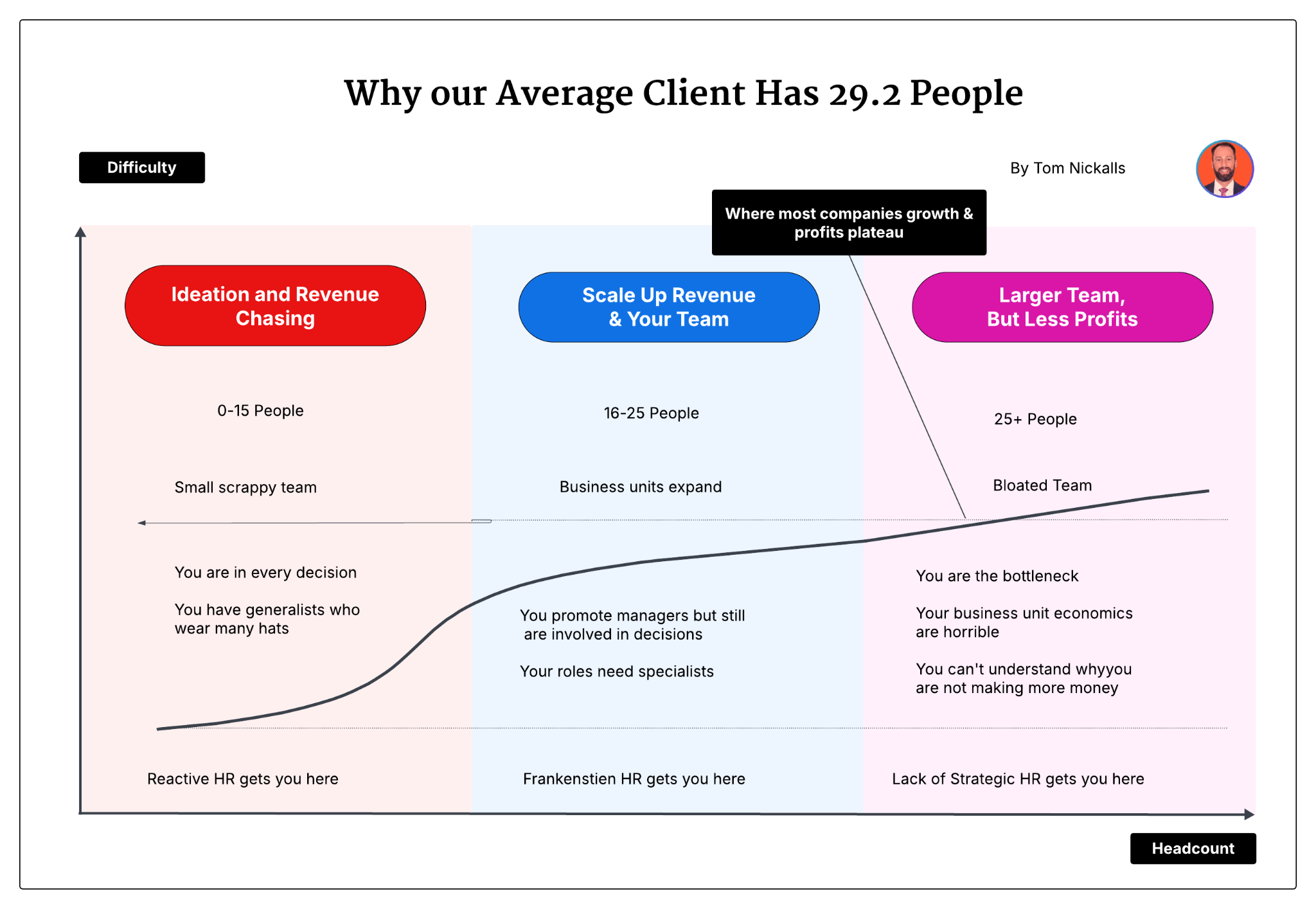
Part of the reason your business might be slowing down is because your team doesn't have the tools and the systems and the skills to be successful. One of those areas is HR. This is where you need to turn a growing headcount into a high-performing team for that next growth stage. Otherwise you're just going to stay where you are.
If you're not in the thick of it, it's easy to judge and ask how this happened. It's pretty simple.
Companies get over 20 people and think they can keep going. Why not? Nobody sends them an email saying “you're now a growth-stage company, you need more systems.” So they keep going. Then they don't get the results, they don't hit the goals, and then they call us.
No founder is flexing that they're the HR person. That's not what they started their business to do. HR has gotten too big to do off the side of your desk. It needs proper attention, and someone who knows how to build these systems and processes. That becomes painfully clear after 20 people are on payroll.
Why do founders wait?
Founders wait to hand off HR for three reasons.
First, there's no one signal that tells them it's time.
Then, there's the budget. If they have to spend money to solve a problem, they will look at alternatives first. When people ask me who Castle HR's competition is, I say literally anything else a company can spend money on. And we get it. You're a small business, and you can't buy everything you want.
And third, problems don't come to a founder's desk labeled “HR,” so they can't always see a pattern building up. Instead, they treat all the HR-related problems as individual fires that they knock out one by one. Someone quits. A critical role stays open for months. You're dealing with the same people problems over and over again. Those issues compound, but only when it's in your face do you start questioning everything and we get a call.
What does waiting actually cost?
To understand what it costs to wait before handing off HR, let's look at two firms.
Firm 1: Brought in fractional HR
- Seats defined
- Hiring rebuilt
- Performance rhythm ran without being chased
- Turnover decreased
By bringing in fractional HR, Firm 1 saved $190K/year.
Firm 2: Continued white-knuckling HR
- Vibe-built their own performance management software instead of using a process
- Conducted partial reviews
- Unfinished job descriptions
- Most recommendations stayed recommendations
Firm 2 took half measures, didn't heed our advice, and didn't see growth or savings. So we ended our engagement. We're not here to experiment. We know how to do this and do it well. We work best with full handover, and so do the companies we work with. We only require one hour of a founder's week. That's it. The rest is on us.
The clear difference between the fates of Firm 1 and Firm 2 came down to ownership. Founders have to let go and let grow. A high-performing team can't form while every decision still runs through you.
If a company isn't ready for real growth, we say no and don't apologize.
What do good HR systems and processes look like?
Good HR systems and processes have three parts: a strategy tied to where the business is going, someone who builds it rather than just recommending it, and a named owner who isn't the founder.
Here's what that covers in a growing company.
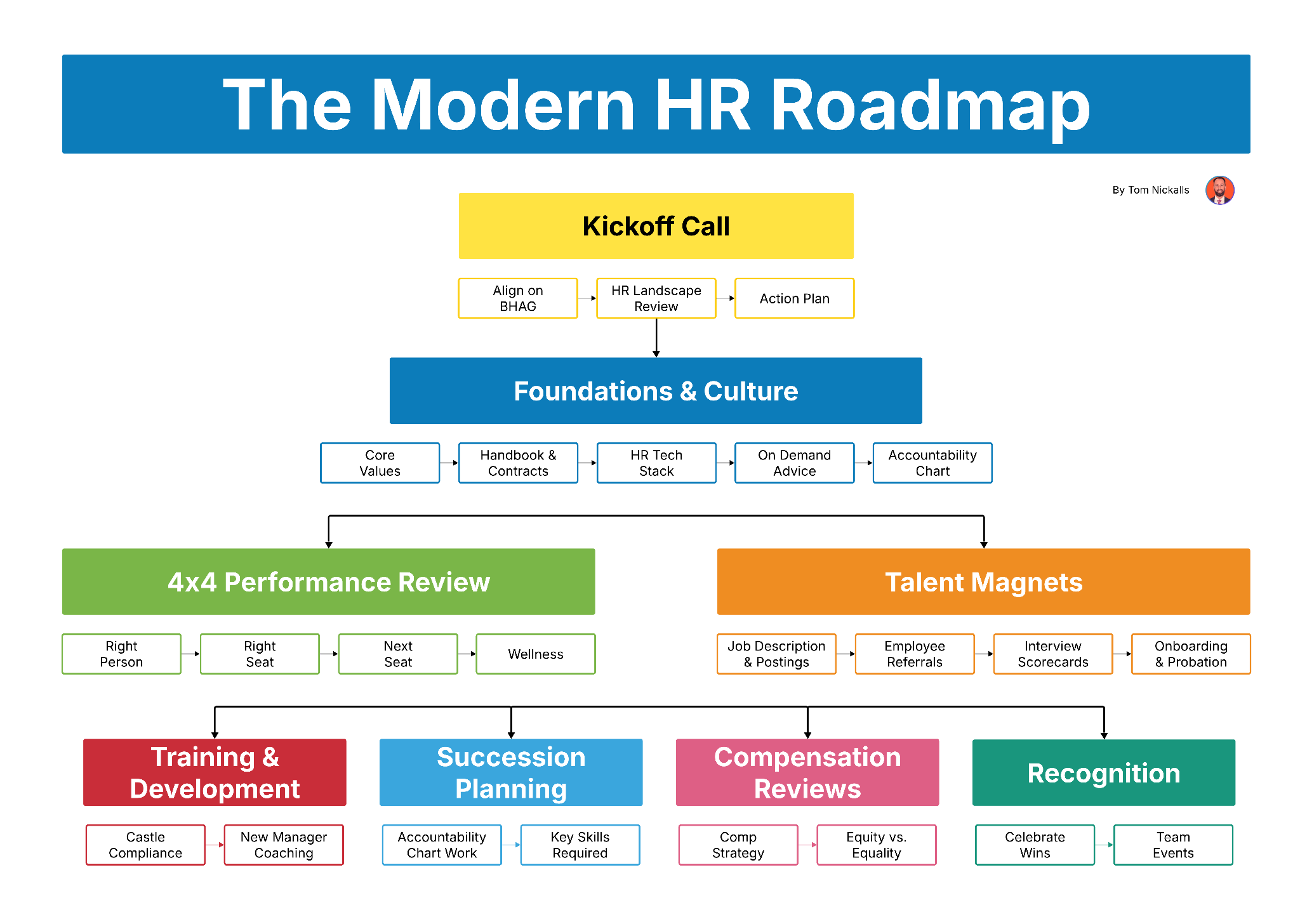
Next, how we get there.
Strategy
When building out a strategy, it's important not to open with “what do you need?” Two reasons for that: the first one is HR partners are not order-takers, they're strategists. And second, founders generally don't have a clear answer to that question. They don't know what they don't know.
It makes more sense to start with “where is the business going?” That's an easier question to answer and puts the end goal front and center, so we build backwards from that.
When you have that understanding, you're setting up your HR function to operate in line with your company's business plan, not in spite of it or outside of it.
Build
Once you have a strategy in place, someone has to build the whole thing. Everything on the modern HR roadmap shown above.
This is where most consultants fall short. They'll wax poetic about what's broken, hand you an expensive report on how to fix it, wish you good luck, and be on their way. Then the harder work lands on the person who already had too much on their plate, you. An effective HR partner sits down next to you and says, “Now let's get you a foundation.”
That means building everything on the roadmap. Exactly what that looks like depends on the business, but the standards stay the same. Part of building these systems is also training managers on them and assigning owners to each one. Without that, the roadmap's just a PDF.
Run
So you and your HR partner have ideated and built the roadmap. Next, you need someone to own it and keep it upright. This is when the handover needs to be complete.
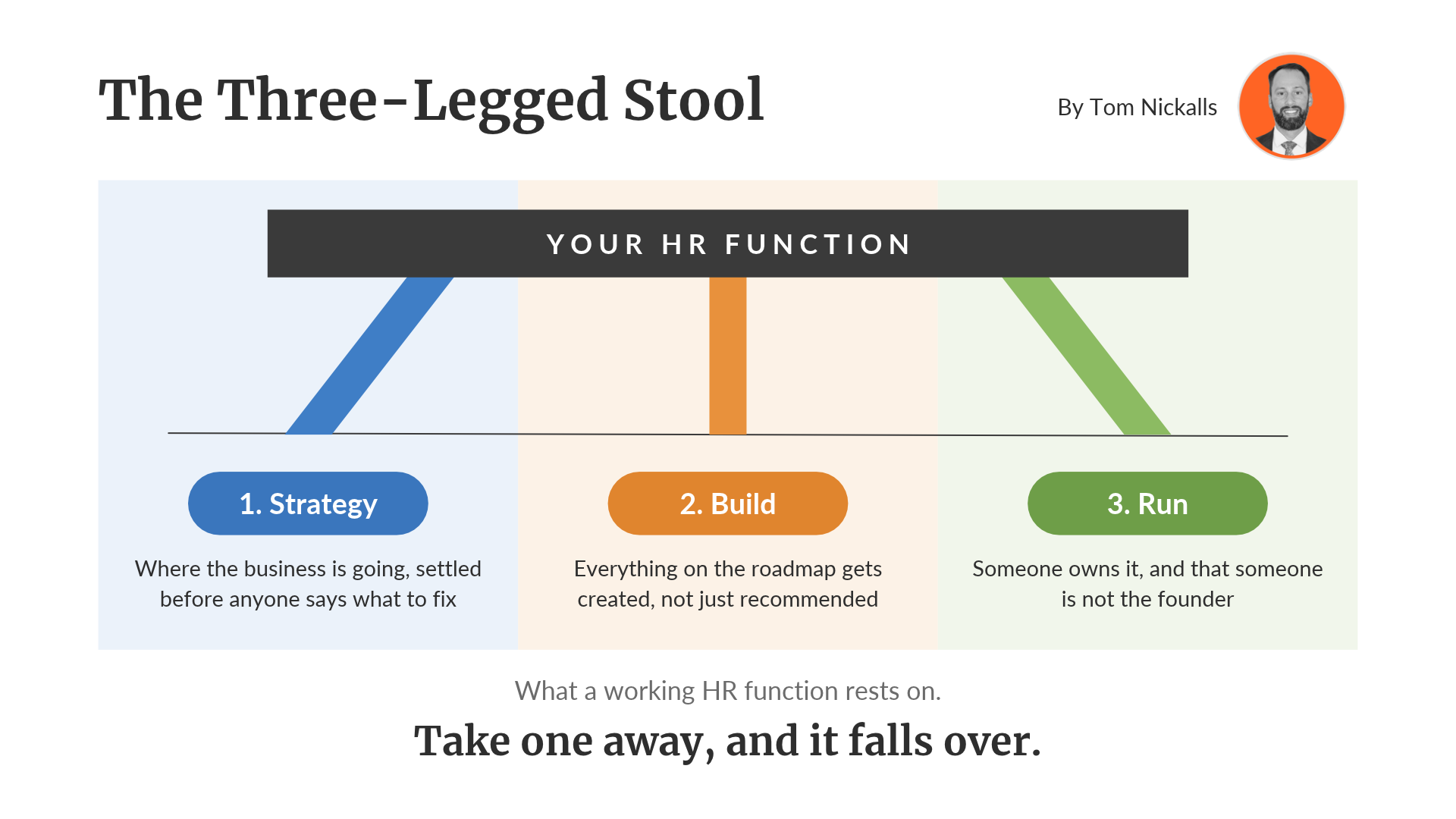
You can have someone internal manage HR with a suite of software, or you can bring in a firm to completely handle it. What's critical here is that the founder should not be in any of these roles. They still need to be involved at a very high level but not on day-to-day matters.
Strategy, build, and run. That's what it takes.
Once you have this set up, it's so much easier to manage. At Castle HR, we only require one hour a week of a founder's time. We handle the rest.
No one joins Castle HR with less than 10 years of experience. The team averages 20. We've served 250-plus companies over the last eight years. That's what helps power a high-performing team.
What if you've already written off HR?
Maybe it's not so easy. Maybe you've been burned before by a generalist. Maybe having a consultant didn't lighten the load. Maybe you hear “HR” and think of all the stereotypes that come along with it.
So let me clear it up.
HR is not the no-fun police that brings you more problems. HR is not a union rep for your team. HR is not there to save the world. HR works top-down from leadership. HR is a system, and high-performance teams start with high-performance systems. HR is what you make it.
You left HR out because you assumed all these negative outcomes. But there's a version that grows the business. Don't take my word for it. Go find out.
Take our Founder Freedom Quiz to find out where you stand and what to do next.
Related posts
.png)
Ready to get people problems off your plate for good?
If people issues are taking over your calendar, the answer is not more guessing, more
templates, or another recruiting fee. It’s time to outsource HR to a proactive senior HR partner who can help you build the people operating systems your next stage requires.