
You See A Talent Shortage, But Your Job Posting Is the Real Challenge.

Why Isn’t Top Talent Applying to Your Roles?
Top talent usually ignores job postings when the role is vague, the salary is hidden, the requirements list is bloated, flexibility is unclear, culture sounds generic, the hiring process feels like a black box, or applying is painful. A strong job posting removes those friction points and shows the right person why the role is worth their attention.
Before spending (read as: wasting) more money on recruiters, sponsored posts, another agency, or a heroic LinkedIn announcement that says “we’re growing,” look at the job posting itself. Most job postings don't give top candidates what they need to click “apply.”
For example, a growth-stage Toronto-based software company trying to hire strong people in a competitive market will struggle with a vague job posting. Being generic will not make this company look flexible, exciting, or mysterious, rather, it makes your company look like it hasn’t thought deeply enough about the role.
And top talent does not wander into a foggy role.
Hiring should be one of the most exciting parts of running a business. You open a critical role, picture the person who will finally take a chunk of work off your plate, and imagine that beautiful little business metric moving up and to the right.
But the all to often reality is you post the job, and one of two things happens:
- Your inbox fills with 500 random applicants, or
- It gets awkwardly quiet.
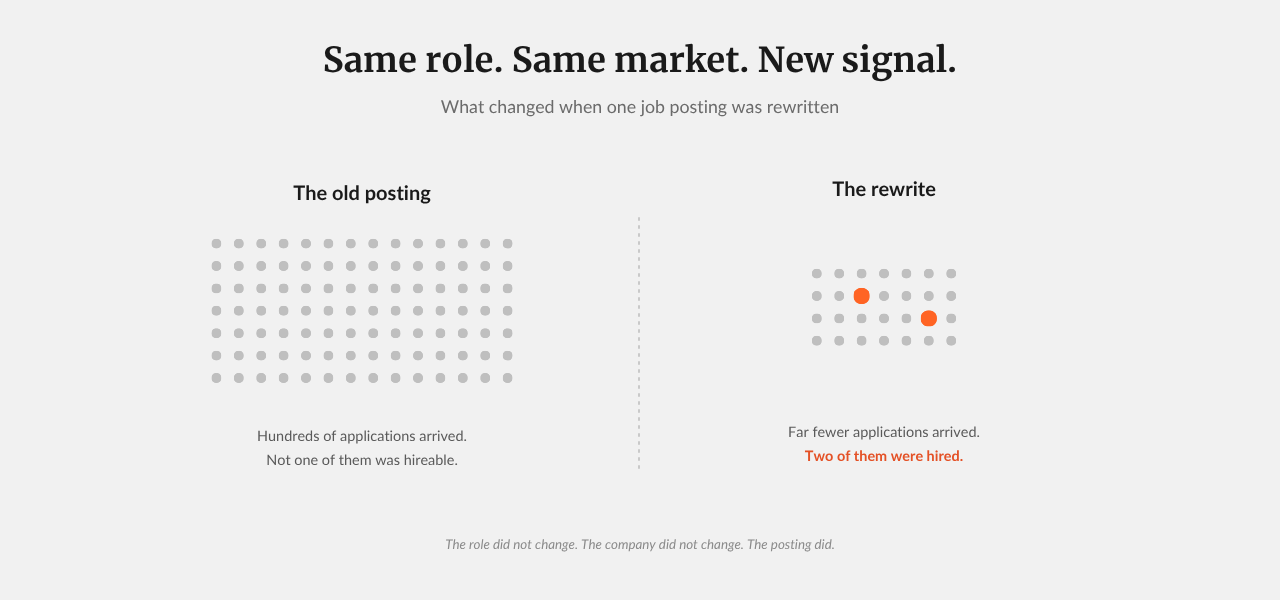
That was the reality for Obsidi, formerly BPTN. They were growing fast and needed to fill a critical role. They put up what most people would consider a “good” job posting, and the applications came in by the hundreds, but the right people did not show up.
On paper, their postings looked like everyone else’s: a long company intro, “competitive salary,” a wall of requirements, vague culture language, and no clear hiring process.
Sound familiar?
When they didn’t find any hireable candidates, they asked Castle HR to revise the job posting. The role, company, and time didn't magically change, but the job posting signal did.
In the first few seconds, candidates could finally understand the role, the mission, and whether it was worth their attention. The result was fewer total applicants, more aligned candidates, and they ended up hiring two people because they were so amazing!
That is the uncomfortable truth.
When most companies struggle to find top talent, it is often not because of a talent shortage, but it is because of the job posting.
The model is simple: Magnet vs. Friction

Every part of your posting is doing one of two things:
- It either acts as a magnet that pulls strong candidates in, or
- It creates friction that gives them a reason to keep scrolling.

The annoying part is that most friction does not look dramatic. It looks like a paragraph about how your company is “fast-paced and passionate.”
Which is cotton candy, all fluff, no substance.
How do high performers evaluate a job posting in 10 seconds?
Top candidates skim for a reason to apply, because they know they will find a role.
They want to know what the role owns, what it pays, where and how they will work, what success looks like, whether the culture is real, and whether the hiring process respects their time.
A-players are not sitting down with a cup of tea to savour 1,200 words of job copy like it is a cottage novel. They scan quickly and ask one question:
Is this worth my attention?
Randstad found that, for the first time in the study’s history, work-life balance beat pay as the leading motivator globally, 83% to 82%.
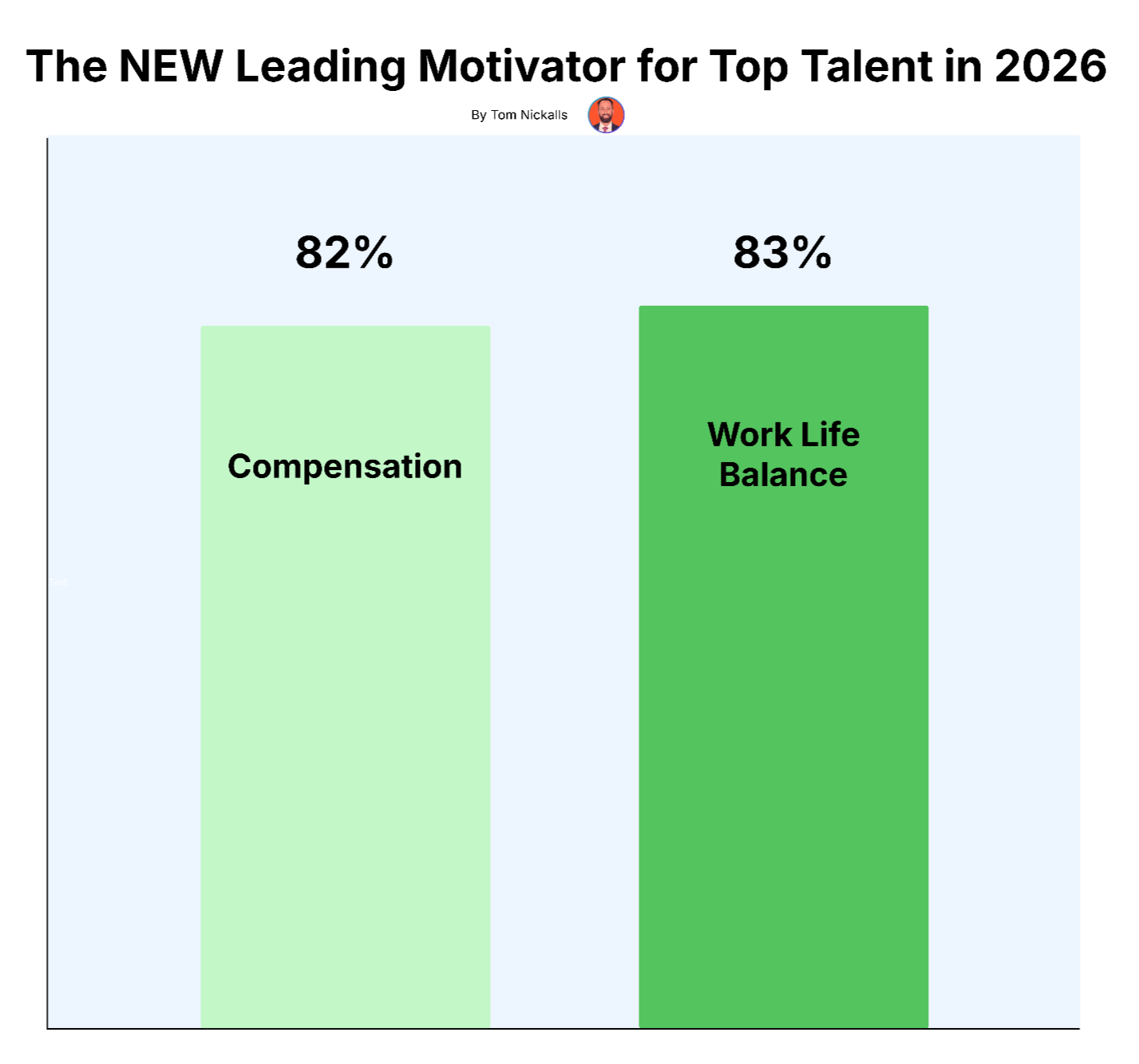
Candidates didn’t stop caring about compensation, they are now judging the whole opportunity, including how the work fits into the rest of their life.
Glassdoor has also reported that 77% of adults would consider a company’s culture before applying, and 73% would not apply unless the company’s values aligned with their own.
Again, candidates are not only asking whether they can do the job, but whether they can see themselves doing the job here.
That is why job postings that read like a list of chores fail today.
A great posting does not just say, “Here are the tasks.”
It says, “Here is the seat, here is the mission, and here is how we put you in a position to win.”
Should you include the salary range in a job posting?
Yes.
Salary transparency builds trust, saves time, and helps candidates decide quickly whether the role makes sense before everyone spends three weeks pretending money is not part of the conversation.
When a posting says “competitive salary,” a strong candidate does not usually think, “Wonderful, a charming mystery.”
They think, “Unknown, annoying, and moving on.”
SHRM found that 82% of workers are more likely to consider applying if the pay range is listed, 74% are less interested when the range is missing, and 73% are more likely to trust organizations that provide pay ranges.
SHRM also found that 66% of organizations listing pay ranges say doing so increased applicant quality.
Top job postings publish a realistic range, include a short note on bonus, commission, equity, or profit share where relevant, and if the company cannot match Big Fancy Brand money, they tell the truth and lean into what they do offer, such as scope, flexibility, ownership, speed, or access to bigger problems.
The added benefit is that salary ranges help people self-disqualify, meaning fewer applications for you to screen later.
How much should you say about the company upfront?
Say enough to create trust, but do not open with a corporate autobiography. The first job of the posting is to show the candidate why the role matters and what their life would look like in the seat.
Most postings open like this:
“Founded in 2013, we are a leading, award-winning provider of innovative, customer-centric solutions…”
And three paragraphs later, the candidate still has no idea what they would actually be doing.
Top candidates have already left the building.
They want to know what problem they are being hired to solve, what kind of team they are joining, why the role exists now, and what a great year in the seat would look like.
You can impress them with awards later, and I’m willing to bet they can Google you if they want the full company story.
The best way to open is to talk directly to your ideal candidate. At Castle HR, we do this in our own postings for Senior HR Pros by speaking to what they actually want: senior-level work, real client impact, flexibility, and not being stranded on an island as the only HR person inside a company that has outgrown founder-led people decisions.
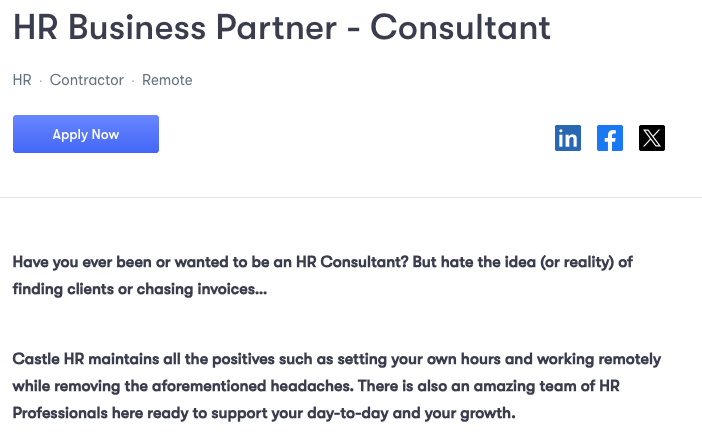
I can say that at any time, Castle HR has a waiting list of Senior HR Professionals interested in joining our team.
The lesson is simple: talk to the person you want, and show them you get them.
Nobody wants to read your corporate memoir before they know if the job is worth caring about.
How long should the job posting requirements list be?
The requirements list should be short enough to filter, not long enough to scare off strong candidates who could succeed. Split real must-haves from nice-to-haves, and do not let a wish list quietly shrink your talent pool.
The 23-bullet requirements section is a quiet little talent killer.
So here is the useful mindset:
If you would not reject a dream candidate over a missing bullet, don't let that bullet stop them from applying.
A better posting splits requirements into two sections. One section is for must-have capabilities, ideally five to seven items. The second is for nice-to-have experience, ideally three to five items. More importantly, the must-haves should read like outcomes, not tool trivia.
“Has led cross-functional projects from idea to launch” is useful.
“Seven-plus years in SaaS, specific degree, five named tools, experience in three industries, and ability to juggle flaming swords while maintaining a positive attitude” is how you accidentally hire nobody interesting.
The goal is not to make the role sound impossible.
The goal is to make the right person think, “That sounds like me.”
How clear should you be on location and flexibility?
Be painfully clear by saying whether the role is remote, hybrid, or in-office, where the person needs to be based, what the rhythm looks like, and why the company designed it that way.
“Hybrid, details in interview” is friction.
Candidates assume the worst when anything is vague.
Remember the salary conversation from five minutes ago? Same problem.
They imagine a role advertised as hybrid that quietly becomes four days in office, or a remote role that turns into “just pop in whenever leadership feels lonely.”
Clarity here saves everyone time.
A better posting says something like, “This role is hybrid in Toronto, with two set office days each week and core collaboration hours from 10 a.m. to 3 p.m. ET.”
For a Toronto-based software company, that might mean being honest about whether the role is downtown Toronto, GTA hybrid, fully remote within Ontario, or tied to specific collaboration days because the team works better together for certain types of work.
That sentence may not feel exciting, but it acts like a magnet for your perfect candidate.
Companies that define things clearly look more serious than companies hoping to negotiate the awkward part later.
How do you show culture without buzzwords?
Show culture through behaviours and values, not slogans. Candidates do not learn much from “great culture” or “we are like a family.” They learn when you explain how values show up in this role, on this team, in real decisions.
This is where job postings turn into cotton candy fast: all fluff, no substance.
“We move fast.”
“We are a family.”
“We are passionate.”
“We wear many hats.”
To a high performer, those phrases can mean nothing. Does “family” mean people care about each other, or does it mean Dave will call at 9:42 p.m. because “we move fast?”
If values matter, translate them into behaviours so applicants can picture what it is actually like to work at your company.
For example, “we value ownership” is fine, but “you will be expected to surface risks early, recommend a path forward, and close the loop when something misses the mark” is much better.
If one of your values is candour, tell the candidate what candour looks like in this seat. Will they need to push back on clients? Challenge internal assumptions? Give direct feedback to peers? Surface bad news early?
That is useful.
Retire “great culture” and let the examples do the work.
How do you show what winning looks like in a job posting?
Add a section that explains what success looks like in the first 12 months. High performers don't want to guess, they are attracted to clear targets to run at.
Responsibility lists are fine because they tell someone what category of work exists. Outcomes tell them what progress the business needs.
“Manage customer relationships” is a responsibility.
“Within six months, you have segmented the customer base, introduced a renewal-risk process, and reduced preventable churn by 15%” is an outcome.
Those are very different signals.
The first tells a candidate the company needs a person, and the second tells a candidate the company has thought about the seat.
A better posting includes a short section called “What success looks like in your first 12 months” and lays it out in three to five outcomes.
Now the right candidate can picture themselves winning in the role, not merely surviving the task list.
High performers want targets, not chores.
Should you explain your hiring process in your job posting?
Of course you should.
A clear hiring process shows candidates the company is organized, respects their time, and takes making a good decision seriously. Silence makes the process feel like a black box.
Top talent dislikes ambiguity, and an unclear hiring process creates friction because they may see it as a sign your company isn't organized.
A better posting includes a small section called “What to expect in our hiring process.” It might say the process includes a short intro call, one deeper interview focused on experience and examples, a practical exercise or work sample with a clear time cap, and a final conversation with a senior leader or peer.
Here is Castle HR’s example for our Senior HR Consultant role:
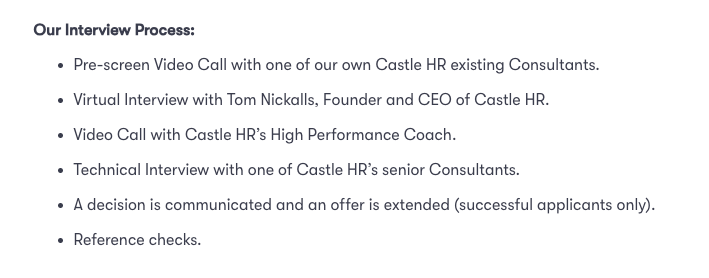
Listing the steps will help your hiring managers because a clear posting lets the team prepare before candidates start applying.
Funny how accountability works when you write it down.
How easy should it be to apply?
Make the first step easy enough for a strong, currently employed candidate to complete without fighting your ATS.
Please… only ask for what you actually need at the start, then add depth later in the process.
You have seen the bad version...
Get asked for a cover letter no one will ever read.
Upload your resume, then retype the same information into 15 tiny boxes.
Create an account to see the questions required.
Answer six essay questions before speaking to a human.
Prove your commitment by completing a labyrinth designed by someone who hates talent.
If your ideal candidate is employed, busy, and reading your posting at 9:30 p.m., they won't battle your application form to prove they care.
iCIMS research found that 95% of people agree the way a potential employer treats them as a candidate reflects how they would treat them as an employee. iCIMS also found that candidates who abandon online applications tend to spend only about four minutes applying before leaving the page.
Ask for a resume or LinkedIn profile, and that is usually enough for the first step.
Save the deeper evaluation for a structured interview or a short, job-relevant work sample.
The goal of the posting is to get the right people to raise their hand, not to grind them down on page one.
If the first step feels painful, the candidate will assume the company does too.
How can outsourced HR or fractional HR help with a job posting?
Good outsourced HR should not just post the role and hope. Strong fractional HR support should help define the seat, sharpen the signal, reduce friction, and build a hiring process managers can actually use.
This is where the bar should be higher.
For companies that outsource HR, the value should not be “someone else uploaded the job posting.” That is not strategy. That is admin with a login.
A strong HR partner should push on the real questions. Why does this seat exist? What outcomes does it need to own? What kind of person will thrive here? What would make a high performer excited to apply? Where are we creating unnecessary friction? What should the interview process prove before we make an offer?
That is why fractional HR can be so useful for a growing company. It brings senior hiring judgment into the process before the company spends weeks screening the wrong people.
If your HR support cannot help turn a vague role into a sharper hiring signal, you may not have the right partner. There's a difference between someone who uploads your job posting and someone who asks why the seat exists in the first place. Castle HR embeds a dedicated Senior HR Pro in your business to build the hiring system behind the posting.
Book a call with me to learn more about the job posting, interview process and scorecards your managers actually use.
How can you apply this today?
Treat your job posting as a strategy, not a form.
A good posting tells the market what the seat owns, what kind of person will thrive, what success looks like, and whether the company is serious enough to deserve the attention of someone strong.
That matters even more once a company crosses around 20 people. At that stage, the founder can no longer personally quality-check every hire, and managers begin building their own teams.
Once they reach the growth stage, they must delegate hiring to their managers.
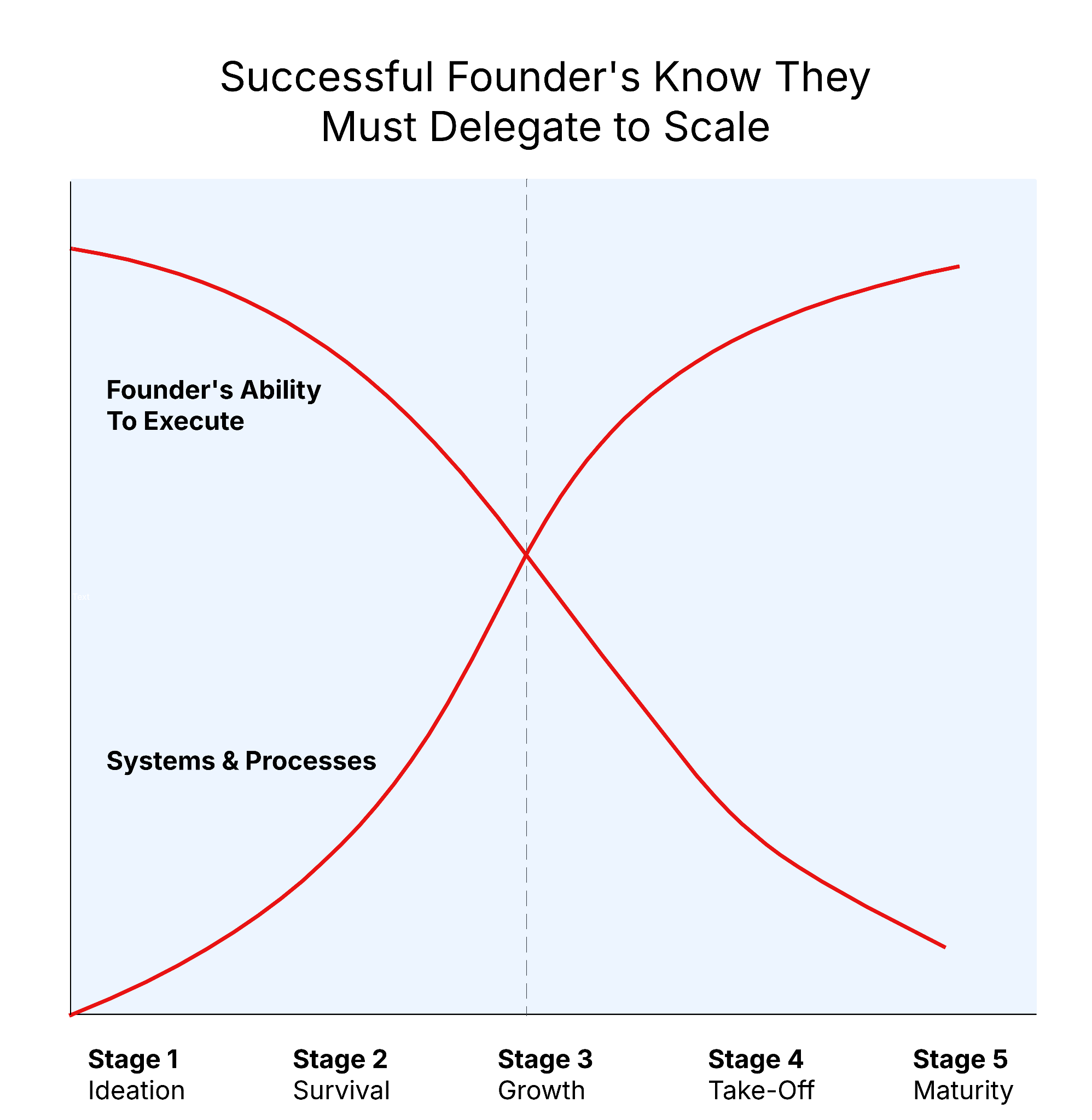
But if each manager writes and hires from a different definition of “great,” every team eventually performs differently.
So pick one critical role this week, sit down with the hiring manager, and use the Magnet vs. Friction lens on pay, location, culture, outcomes, process, and apply flow.
Cut everything that causes friction and add in the magnetic parts top candidates want.
If you want a simple test, send the revised posting to one or two current top performers and ask them two questions: “If you saw this when you were job hunting, would you have applied?” and “What would have made you hesitate or scroll on?”
If you do this well, three things are likely to happen.
- You will receive fewer applicants.
- You will attract stronger applicants.
- You will gain time back because the posting is doing its job.
A job posting is the first handshake with the person you hope will help build the next chapter of your company.
Top talent is not hiding.
They are filtering out vague companies before the first interview.
Your Job Postings Aren't The Only Thing Running Through You
Hiring is one seat at the table.
If onboarding, performance conversations, and every awkward people decision still land on your desk, the vague job posting isn't the problem. It's a symptom.
Find out how much of your people's operation is still running out of your own head.
Learn here if your HR strategy is actually accelerating growth or devastating your profit in just 4 minutes
Take 4-minutes to get your Founder Freedom Score and see where your business still depends on you, the gaps that are costing you the most, and where to start so you can build the people operating system to free yourself up to grow your business.
Related posts
.png)

.png)
Ready to get people problems off your plate for good?
If people issues are taking over your calendar, the answer is not more guessing, more
templates, or another recruiting fee. It’s time to outsource HR to a proactive senior HR partner who can help you build the people operating systems your next stage requires.